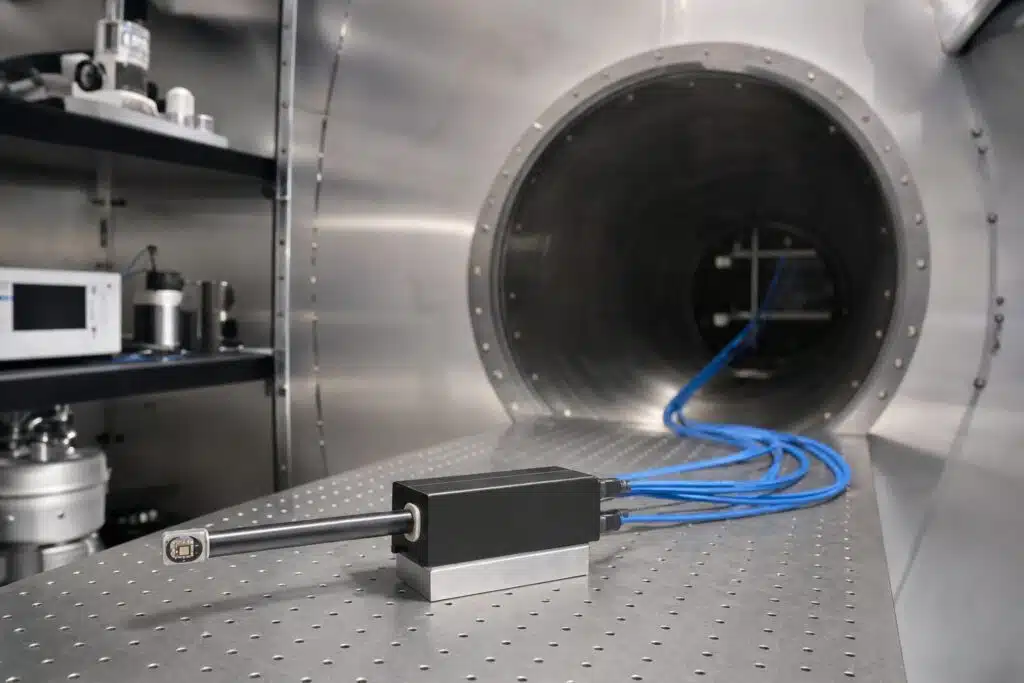
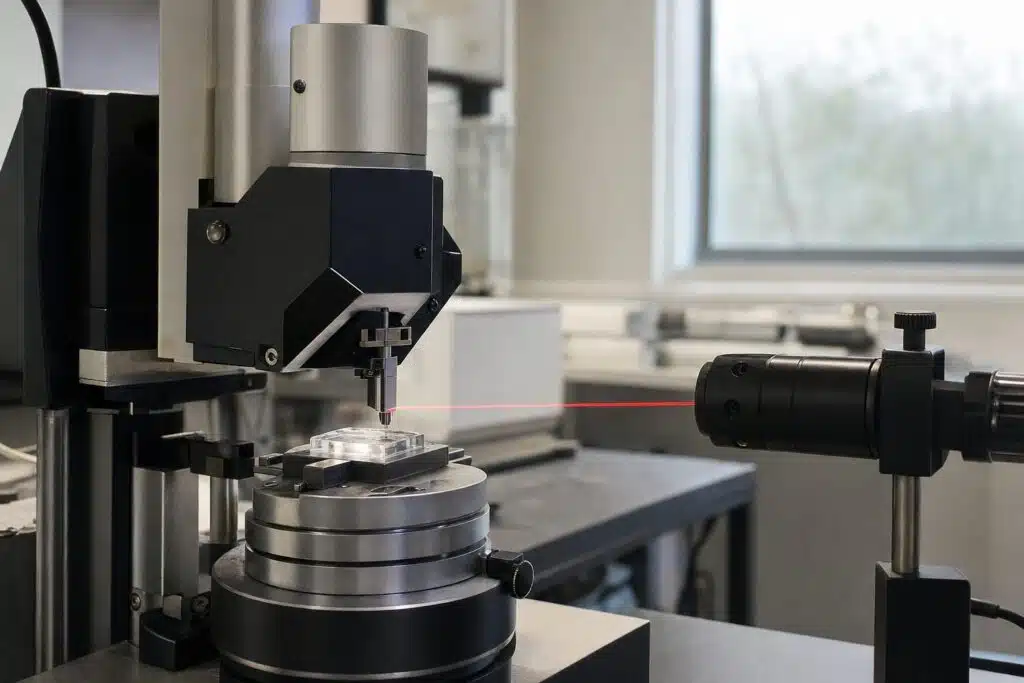
A compression load cell is a force sensor that measures a pushing load: the force squeezes a metal spring element, strain gauges bonded to it change resistance, and the cell returns a small voltage proportional to the force. Compression cells come as buttons, low-profile pancakes, canisters and through-hole donuts, and the right shape depends on how much space you have, how the load is applied and how much off-axis force the setup creates. This guide explains each type and how to choose one, as part of our mechanical sensors and load cell coverage.
Key takeaways
- Strain gauge load cells typically output 1 to 3 mV/V at rated load, so a 2 mV/V cell on 10 V excitation gives 20 mV at full scale.
- Button load cells fit tight spaces; FUTEK makes them from about 6 mm (1/4 in) to 76 mm (3 in) outer diameter.
- Low-profile and pancake cells trade height for stiffness and side-load rejection; high-precision models reach ±0.02% of rated output nonlinearity.
- Donut (through-hole) cells measure bolt preload and clamping force around a fastener.
- Most compression measurement errors come from misalignment and uneven contact, not from the cell itself.
Table of Contents
What Is a Compression Load Cell?
A compression load cell is a transducer designed to measure force applied toward the sensor, for example a press ram pushing down, a weight resting on a platform or a part being squeezed in a test fixture. Some cells measure compression only; others, such as S-beam and universal pancake designs, measure both compression and tension. Flintec describes the classic compression cell as a column or canister with mounting surfaces at the top and bottom and a central element that carries the load.
Compression only or compression and tension?
If the force only ever pushes, a compression-only cell is usually simpler, stiffer and cheaper to mount. If the force reverses, as in fatigue testing or a mechanism that pulls and pushes, choose a bidirectional cell. Our companion guide to the tension load cell covers the pulling side.
How Does a Compression Load Cell Work?
Inside every strain gauge load cell is a carefully machined spring element, usually aluminium or stainless steel. Under load it deforms by a tiny, repeatable amount. Foil strain gauges bonded to the element stretch or shorten with it, and four gauges wired as a Wheatstone bridge convert that deformation into a voltage ratio. Bridge resistances of 350 Ω are typical, with 120 Ω and 1,000 Ω also used.
From millivolts to newtons
The output is tiny. Typical sensitivity is 1 to 3 mV/V, and maximum excitation is commonly around 15 V. As a worked example, a cell rated at 2.96 mV/V excited at 10 V delivers 29.6 mV at full rated load. That signal needs a load cell signal conditioner or amplifier before a PLC, data logger or display can use it, and it needs calibration to convert it into force units.
Why stiffness matters
A stiffer element deflects less, which keeps the test geometry stable and raises the natural frequency. FUTEK quotes frequency response up to about 20 kHz for its load button designs, which is why buttons are used for fast impact and press-fit events as well as static loads.
What Types of Compression Load Cells Are There?
Button load cells
A button cell has a single raised, usually domed, loading surface on a small round body. FUTEK's Button load cells range from roughly 6 mm to 76 mm in diameter and are built for compression in tight spaces, between mating surfaces or under a contact point where a conventional cell would not fit. The domed button tolerates small angular misalignment, but it must still be loaded close to its centre.
Low-profile and pancake load cells
Low-profile cells are flat and wide, with a large bearing diameter. The FUTEK Low Profile line is optimised for compression in test machines, hydraulic presses and structural frames where high stiffness and minimal deflection matter. The Universal Pancake adds tension capability and strong lateral load rejection; FUTEK lists high-precision models with nonlinearity of ±0.02% of rated output.
Canister and column load cells
Canister cells are cylinders that carry the load through a central column. They suit high capacities: FUTEK's miniature column and canister models cover roughly 2,000 to 30,000 lb (about 8.9 to 133 kN). Flintec notes that column designs are often hermetically sealed for harsh environments and are common in silo and vehicle weighing.
Donut (through-hole) load cells
A donut cell has a central bore so a bolt, shaft or cable passes through it. The FUTEK Donut is used for bolt-load monitoring, clamping force and preload verification without interrupting the assembly.
Compression Load Cell Types Compared
| Type | Load direction | Size and capacity guide | Best for |
|---|---|---|---|
| Button | Compression | About 6 to 76 mm diameter; response up to ~20 kHz | Tight spaces, press-fit, contact force |
| Low profile | Compression | Flat, wide bearing surface, high stiffness | Presses, test frames, structural tests |
| Universal pancake | Compression and tension | Nonlinearity down to ±0.02% RO | Precision testing with side loads |
| Canister / column | Compression | About 2,000 to 30,000 lb (8.9 to 133 kN) | High-capacity static loads |
| Donut / through-hole | Compression around a bolt | Central bore sized to the fastener | Bolt preload, clamping force |
| S-beam | Compression and tension | Compact S-shaped bending beam, mounts inline | Test stands, hanging and inline loads |
How Do You Choose a Compression Load Cell?
1. Capacity with headroom
Pick a rated capacity above your highest expected force, including shocks and dropped loads, but not so far above that the working signal becomes a small fraction of full scale. A load that uses only 5% of the range also uses only 5% of the available millivolts, which worsens resolution.
2. Space and mounting
Measure the height available first. If the stack-up allows only a few millimetres, a button is often the only option. If you have room and need rigidity, a low-profile cell on a flat, hardened base performs better.
3. Off-axis and side loads
Real fixtures rarely push perfectly along the axis. Pancake designs with multiple shear struts reject lateral load better than a small button. If side loads are unavoidable, use a load button with a mating load pad, or move to a multi-axis sensor that measures them instead of suffering from them.
4. Accuracy you actually need
Nonlinearity, hysteresis and repeatability each add error. Our guide to load cell accuracy explains how to combine them, and the zero balance article covers the offset at no load.
How Should You Install It?
- Align the load path: Flintec stresses that proper alignment during installation is vital for accurate readings, usually achieved with purpose-designed mounting hardware.
- Use flat, hard, parallel surfaces: uneven contact concentrates stress and shifts the reading.
- Protect against overload: add a mechanical stop if shock loads can exceed capacity, because overload can permanently shift the zero.
- Calibrate in the final fixture: mounting changes the offset, so calibrate after installation.
- Route and strain-relieve the cable: a pulled cable can damage the gauge connections inside small buttons.
NewRoad has been the authorized FUTEK distributor in Israel since 2006. FUTEK designs and manufactures its sensors in Irvine, California, and operates a certified calibration laboratory, so cells can be supplied with a calibration certificate. See the full range on the FUTEK page.
Frequently Asked Questions
What is a compression load cell used for?
It measures pushing forces, for example press force, contact force between parts, weight on a platform or bolt preload, and converts them into an electrical signal.
What is the output of a compression load cell?
Strain gauge load cells typically output 1 to 3 mV per volt of excitation at rated load, so a 2 mV/V cell on 10 V gives 20 mV at full scale.
What is the difference between a button and a pancake load cell?
A button is small and measures compression in tight spaces. A pancake is wider and flatter, more rigid, rejects side loads better and often measures tension as well.
Can a compression load cell measure tension?
Only if it is designed for both directions. S-beam and universal pancake cells measure compression and tension; button and canister cells are usually compression only.
Why does my compression load cell read differently each time?
The usual causes are misaligned loading, uneven or soft contact surfaces, cable strain and temperature changes. Fix the mounting first, then recalibrate with the two-point or multi-point method.
Where can I buy FUTEK compression load cells in Israel?
NewRoad is the authorized FUTEK distributor in Israel since 2006 and supplies button, low-profile, pancake and donut load cells with calibration certificates.
Need help sizing a compression load cell for your fixture?
Sources: Flintec, Compression Load Cell Explained; FUTEK, Load Cells; Load cell (sensitivity and bridge values) (verified October 2026). The 2 mV/V and 10 V figures are illustrative arithmetic.
Last updated: October 2026.