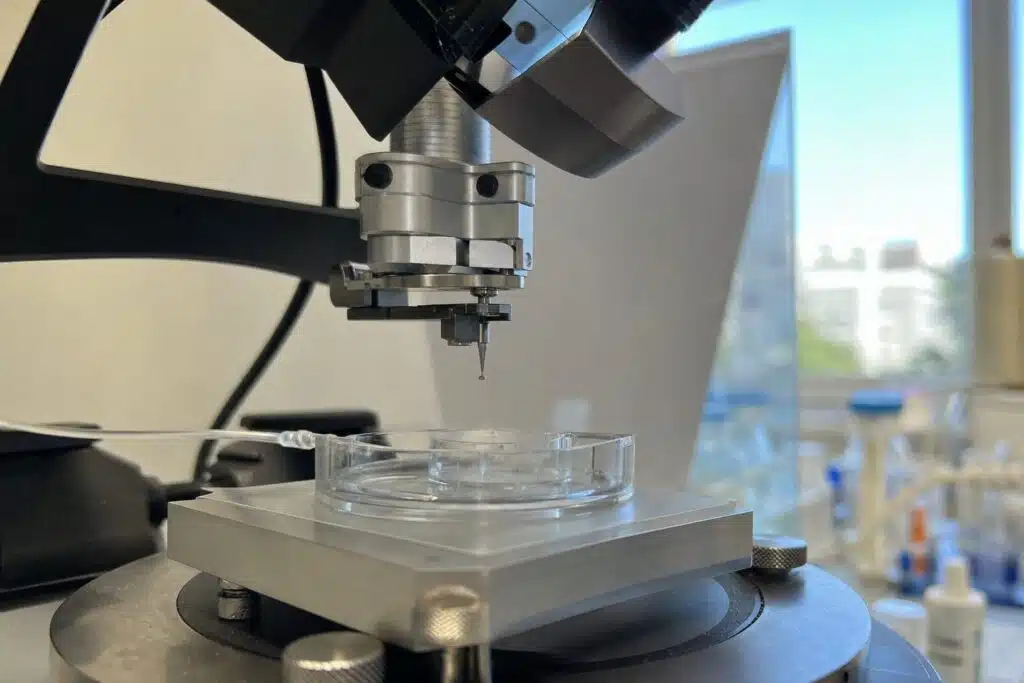
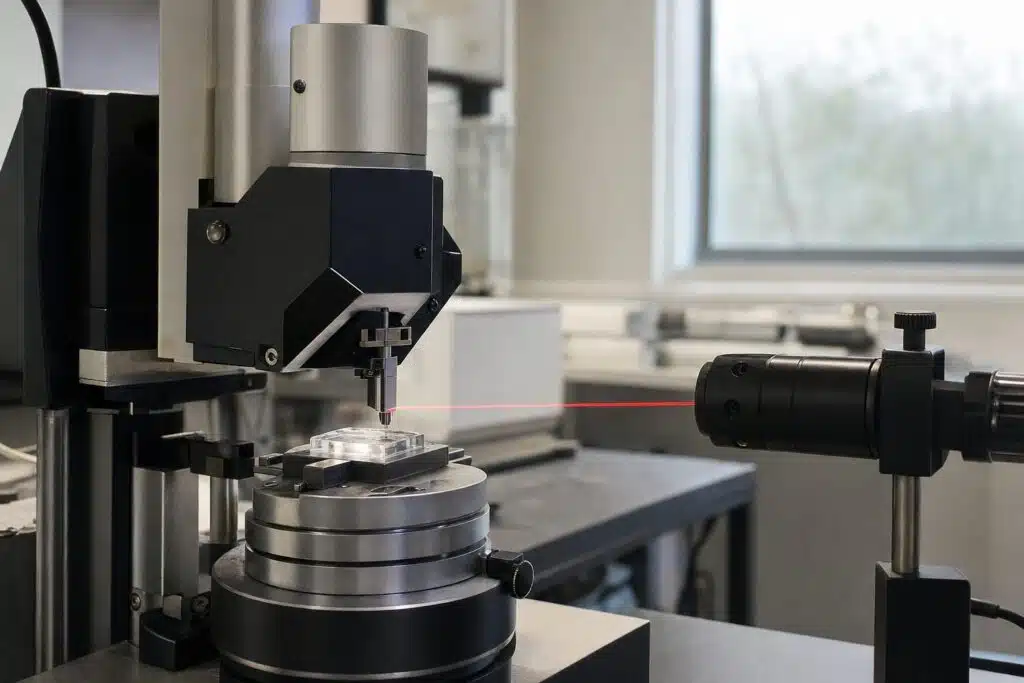
Contact angle measurement quantifies how a liquid wets a solid by imaging a drop on the surface and measuring the angle where the liquid edge meets the solid. A small angle means the liquid spreads and the surface is wettable. A large angle means the liquid beads up. The number matters for coatings, adhesives, printing, cleaning and biomaterials, because it reflects surface energy and surface cleanliness. This guide covers the methods, the difference between static and dynamic angles, what the result means, and common sources of error. For instrument selection, see contact angle goniometers.
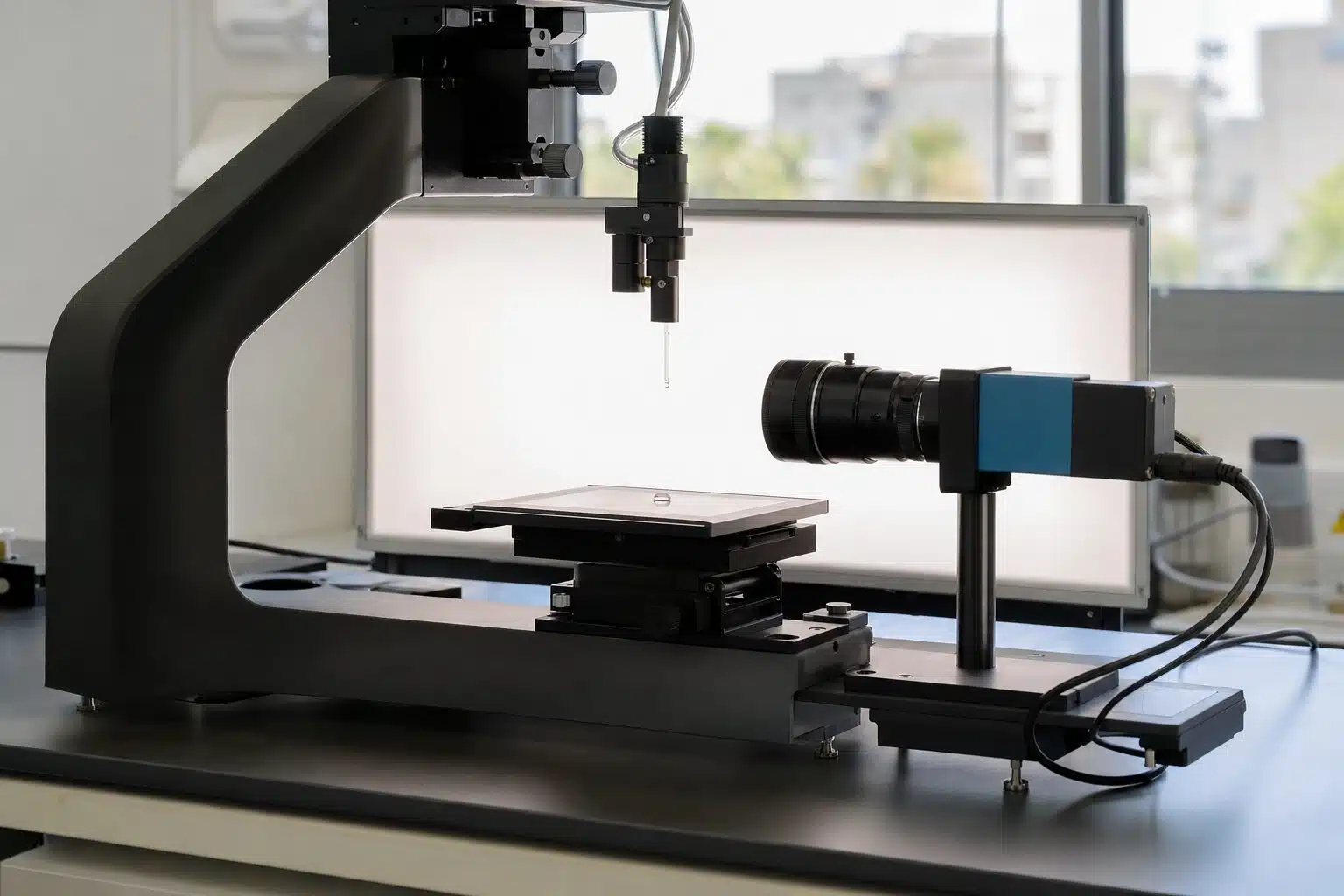
Table of Contents
- What Does the Contact Angle Tell You?
- How Is It Measured With the Sessile Drop Method?
- What Is the Difference Between Static and Dynamic Angles?
- How Do You Get Surface Free Energy?
- What Causes Poor Repeatability?
- How Should You Prepare Samples and Liquids?
- What Should You Look for in an Instrument?
- Where Is It Used in Industry?
- Frequently Asked Questions
What Does the Contact Angle Tell You?
The angle is measured through the liquid, between the solid surface and the tangent to the drop at the contact line. Below about 90 degrees the surface is generally called wetting, above 90 degrees non-wetting. For water, these are called hydrophilic and hydrophobic surfaces. The balance of surface forces behind the angle is described by Young's equation, which the contact angle article on Wikipedia explains.
Why it matters
Adhesion, paint spreading, ink printing and fluid flow in microchannels all depend on wetting. A surface that looks clean can still repel water because of a thin contaminant layer, which a contact angle test reveals in seconds.
How Is It Measured With the Sessile Drop Method?
The sessile drop method is the standard. The steps are simple.
- Place the sample on a level stage and light it from behind so the drop shows as a sharp silhouette.
- Deposit a drop of a known liquid, usually water, with a controlled volume from a needle.
- Capture an image with a high-resolution camera.
- Fit the drop shape with software, which finds the baseline and calculates the angle on both sides.
Optical tensiometers like those described on our optical tensiometer technology page image a drop resting on a surface (sessile) or hanging from a needle (pendant) and use drop shape analysis to calculate contact angle, surface tension and interfacial tension.
What Is the Difference Between Static and Dynamic Angles?
| Measurement | What it describes | Typical use |
|---|---|---|
| Static contact angle | Angle of a drop at rest | Quality control, surface treatment checks |
| Advancing angle | Angle as the contact line moves over dry surface | Wetting behavior, coating spread |
| Receding angle | Angle as the contact line retreats | Liquid release, self-cleaning surfaces |
| Hysteresis | Advancing minus receding angle | Surface roughness and chemical heterogeneity |
| Roll-off angle | Tilt at which a drop starts to slide | Water repellent surfaces |
Biolin Scientific lists these modes for its Theta Lite: static contact angle by sessile drop, captive bubble and meniscus, dynamic contact angle including advancing, receding, hysteresis and roll-off angle, surface free energy, and surface and interfacial tension by pendant drop. A batch sessile drop mode serves quality control. For wafer work, the same range is offered on the Theta Wafer with full automation on silicon wafers.
How Do You Get Surface Free Energy?
Measuring the angle of two or more liquids with known surface tension lets software calculate the surface free energy of the solid, using models such as Owens-Wendt. Water and diiodomethane are a common pair. Surface energy predicts how well adhesives and coatings will bond, so it is a core number in surface treatment work.
What Causes Poor Repeatability?
- Contamination. Fingerprints, dust and oils change the angle strongly. Handle samples with clean gloves and tweezers.
- Drop volume. Differences in volume change the apparent angle on rough surfaces. Automatic dosing keeps it identical.
- Baseline error. Wrong baseline placement is the most common software error, so check the fit on each image.
- Evaporation. Small drops evaporate quickly, so measure soon after deposition.
- Surface roughness and tilt. A tilted stage biases the left and right angles.
- Time. Some surfaces, such as plasma treated polymers, change over hours, so record the time since treatment.
Report the mean of several drops at different positions, with the standard deviation, instead of a single value.
How Should You Prepare Samples and Liquids?
Preparation decides repeatability more than the instrument does. Clean the surface with a suitable solvent, allow it to dry fully and avoid touching the test area. Use fresh, high-purity water, because even small amounts of surfactant lower the surface tension and shift the angle. Keep the room temperature steady, since both liquid properties and evaporation depend on it.
Choosing the test liquid
Water is the default for hydrophobicity. Add a second, nonpolar liquid such as diiodomethane when you need surface energy, and match the drop size to the roughness scale of the sample. On porous or absorbing materials, record the angle at a fixed time after contact, since the drop soaks in.
Documenting a test
Record the liquid, drop volume, temperature, humidity, time after deposition and the number of drops. That context lets someone else reproduce your result and compare it with a specification.
What Should You Look for in an Instrument?
Choose a high-resolution camera, a stable, level stage, automatic droplet deposition and software with live subpixel analysis. Biolin Scientific says its OneAttension software supports every measurement mode with live results. Compact instruments suit quality control, while research systems add tilting stages, temperature control and automation. Our guide on contact angle goniometers helps you compare options.
Surface tension from the same system
The pendant drop method uses the same camera. A drop hanging from a needle takes a shape set by gravity and surface tension, and the software fits it to calculate the surface tension of the liquid. That makes one instrument useful for both solids and liquids.
Where Is It Used in Industry?
Coating and printing lines use contact angle to check whether a plasma, corona or chemical treatment has made a surface receptive. Medical device makers check the wettability of implants and lenses. Semiconductor fabs verify surface cleanliness on wafers. Textile and packaging engineers confirm water repellency, and cleaning chemistry teams compare detergents by how well they wet a soil or a metal part. In each case the test is fast, needs only a small amount of liquid and does not damage the sample.
Need a contact angle meter for quality control or research?
Frequently Asked Questions
What is contact angle measurement?
It measures the angle between a liquid drop and a solid surface, which shows how well the liquid wets the surface.
What is a good contact angle?
It depends on the goal. Under 90 degrees means wetting and over 90 degrees means non-wetting. Adhesion and coating usually need low angles, while water repellency needs high ones.
What is the sessile drop method?
A drop is placed on a flat surface, imaged by a camera, and software fits its shape to calculate the contact angle on both sides.
What is contact angle hysteresis?
It is the difference between the advancing and receding contact angles, and it reflects surface roughness and chemical heterogeneity.
Can contact angle give surface free energy?
Yes. Measuring angles of two or more liquids with known surface tension lets software calculate the solid surface free energy.
Why are my contact angle results inconsistent?
Common causes are contamination, varying drop volume, baseline errors, evaporation and a tilted stage.
Last updated: November 2026