An atomic magnetometer detects extremely weak magnetic fields by using lasers to spin-polarize alkali metal atoms in a small cell and reading how the atoms respond to the field. Because the response of the atoms is tied to fundamental constants, these sensors reach femtotesla sensitivity in a package small enough to hold in the hand, and without the cryogenic cooling that older ultra-sensitive sensors needed. This guide explains the principle in plain terms, lists the key specifications using data from the manufacturer page, and covers where the technology is used. For a different quantum approach, see our quantum NV magnetometry overview.
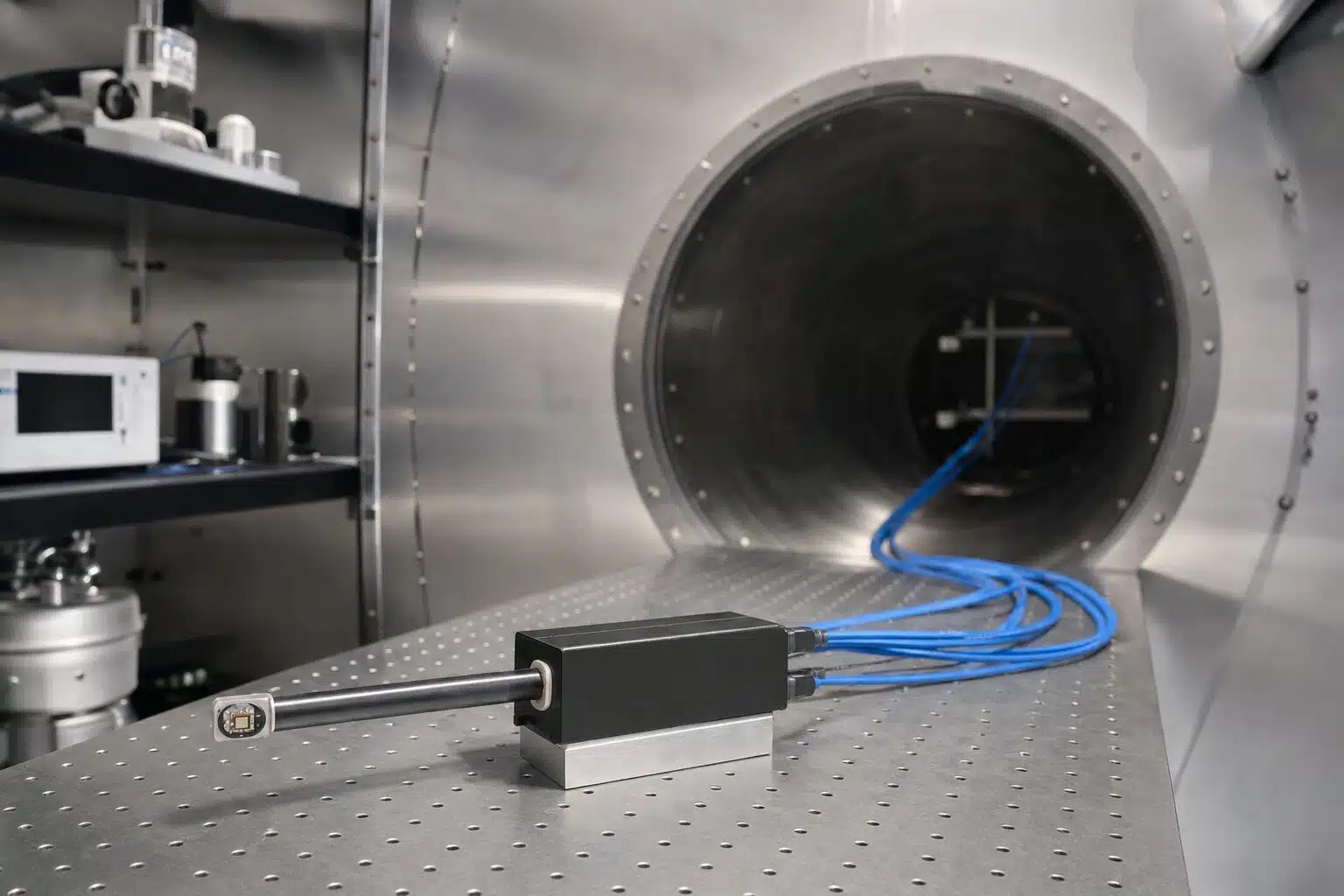
Table of Contents
How Does an Atomic Magnetometer Work?
The sensor uses the spin of the outer-shell electrons of alkali metal atoms, such as rubidium. A pump laser spin-polarizes the atoms in a vapor cell, so their spins point in the same direction. In a weak magnetic field the spins undergo Larmor precession, rotating at a rate proportional to the field strength. A second, detection laser passes through the cell, and the way the atoms absorb or rotate its light reveals the precession and therefore the field. The magnetometer article on Wikipedia lists the main types.
Why the field must be small
Optical pumping works best when the spins can precess freely, so many atomic magnetometers operate near zero field or in a magnetically shielded space. That is why a stated background field range, such as plus or minus 100 nT, is part of the specification.
What Are the Key Specifications?
| Parameter | SpinMag-I value |
|---|---|
| Atom | Rubidium-87 |
| Sensitivity | Below 15 fT/√Hz |
| Bandwidth | 1 to 100 Hz |
| Measurement range | ±5 nT |
| Measuring direction | Z, Y, or Z and Y |
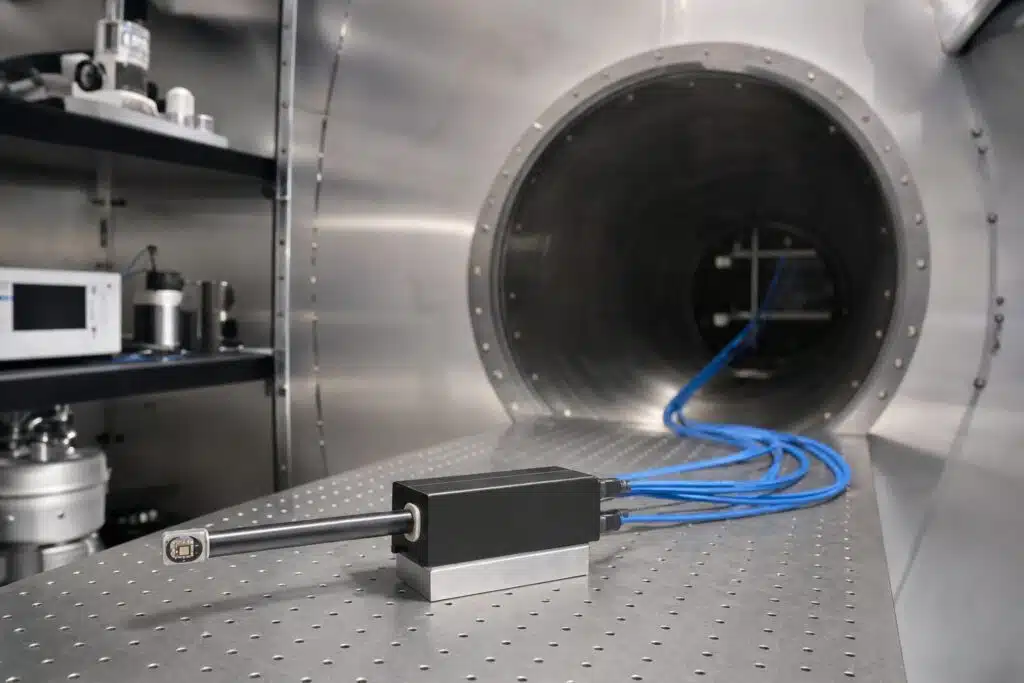
| Probe size | 30 × 16 × 12 mm |
| Channels | Expandable up to 256 |
| Output | Analog and digital signal |
These figures come from the CIQTEK specifications for the SpinMag-I atomic magnetometer, sold in Israel through NewRoad. The manufacturer highlights high sensitivity, small size, low energy consumption and portability.
How Does It Compare With Other Magnetic Sensors?
- SQUID sensors have been the standard for biomagnetism and are very sensitive, but they need cryogenic cooling with liquid helium.
- Fluxgate and Hall sensors work at room temperature but are far less sensitive.
- NV-diamond sensors work at room temperature with nanoscale spatial resolution, and are described in our guides on the quantum diamond microscope and ODMR.
- Atomic magnetometers reach femtotesla sensitivity without cryogenics, in small probes that can be arranged in arrays.
Each technology has a niche. Atomic sensors lead where sensitivity to slow, weak biological and geophysical signals matters, and NV centers lead where spatial resolution matters.
Where Are Atomic Magnetometers Used?
CIQTEK lists three application areas for its atomic magnetometers: multi-channel cardiac magnetic measurement, magnetoencephalography including wearable systems, and weak magnetic field research.
- Magnetocardiography (MCG). The heart produces a magnetic field that carries information about its electrical activity without electrodes on the skin.
- Magnetoencephalography (MEG). Neural currents produce tiny fields, and room-temperature sensors can sit closer to the scalp than helium-cooled ones, a point covered in the magnetoencephalography article.
- Weak-field research. Physics experiments, materials studies and geomagnetic work need low noise and good stability.
Why channel count matters
Mapping a field distribution needs many sensors at once. A probe that is only 30 by 16 by 12 mm and expandable to 256 channels makes dense arrays practical, which improves spatial coverage and lets researchers separate signal sources from noise.
What Do Femtotesla Figures Mean?
A tesla is the unit of magnetic flux density. The Earth field is about 50 microtesla, a refrigerator magnet is a few millitesla, and the field from the human heart at the chest surface is on the order of tens to hundreds of picotesla. Fields from the brain are smaller still, in the femtotesla range. Sensitivity in fT/√Hz tells you the noise floor per square root of bandwidth, so a lower number means the sensor can resolve a weaker signal. Because noise integrates over bandwidth, the same sensor looks noisier in a wider band, which is why the 1 to 100 Hz bandwidth is stated alongside the sensitivity.
Dynamic range and the working window
A sensor with a range of plus or minus 5 nT is tuned to resolve tiny changes around a near-zero field. It is not a compass. If the ambient field leaves that window, the sensor must be recentered by shielding or compensation coils, which is why setup matters as much as the probe itself.
What Are the Limitations?
Atomic magnetometers are sensitive to everything magnetic, including passing vehicles, elevators and power lines, so unshielded operation limits performance. Bandwidth is modest compared with some other sensors, which suits biological signals but not fast transients. Heated vapor cells need temperature control, and the probe can add some heat near the subject. Finally, systems with many channels need careful calibration to match gain and orientation across the array.
What Does a Practical Setup Need?
Atomic magnetometers need a quiet magnetic environment. A magnetic shield, active field compensation or both reduce the ambient field to the working range, and gradiometer arrangements subtract common noise. Laser control, temperature control of the vapor cell and low-noise electronics are part of the instrument. Users also plan data acquisition, since signals in the 1 to 100 Hz band are slow, and filters for mains frequency and its harmonics are essential.
Measurement direction
Some sensors measure one axis of the field, while others measure two. The SpinMag-I offers Z, Y, or Z and Y measuring directions, so the choice depends on whether you need a vector or a single component.
Questions to ask before buying
Ask about the working field range, how the sensor handles drift, what shielding is recommended, how channels are synchronized, and what software and output formats are supported. Ask for a demonstration in an environment similar to yours, because the shielding and noise setting define real-world performance.
Exploring atomic magnetometers for biomagnetic or weak-field research?
Frequently Asked Questions
What is an atomic magnetometer?
It is a sensor that uses spin-polarized alkali atoms in a vapor cell and lasers to measure extremely weak magnetic fields.
How sensitive is an atomic magnetometer?
The CIQTEK SpinMag-I reaches below 15 fT/√Hz over a 1 to 100 Hz bandwidth, according to the manufacturer.
Does an atomic magnetometer need cooling?
No cryogenic cooling is needed, which is a key difference from SQUID sensors. The vapor cell is usually heated and temperature controlled.
What are atomic magnetometers used for?
Typical uses include magnetocardiography, magnetoencephalography including wearable systems, and weak magnetic field research.
How is it different from NV-diamond magnetometry?
Atomic sensors offer very high field sensitivity in the low-frequency range, while NV centers offer nanoscale spatial resolution and a wide operating range.
How many channels can the SpinMag-I have?
It is expandable up to 256 channels, with a probe size of 30 × 16 × 12 mm.
Last updated: November 2026