Passive vibration isolation works by giving the supported load a resonant frequency far below the disturbances it needs to reject; active isolation instead senses residual motion and drives an actuator to cancel it in real time. The two are not simply "better" and "worse" — passive isolation handles the overwhelming majority of lab instrumentation, and active isolation earns its added cost and complexity only once a process genuinely depends on sub-micrometre stability.
Table of Contents
- How Vibration Isolation Actually Works
- Passive vs. Active Isolation: Side-by-Side
- Passive Isolator Types and Their Frequency Ranges
- Three Mistakes Labs Make When Choosing
- When to Choose Passive, Active, or a Site Survey First
- What a Site Vibration Survey Actually Checks
- What Is AFM and Why Does It Set the Isolation Requirement?
- Frequently Asked Questions
How Vibration Isolation Actually Works
Every passive isolator behaves as a spring-and-mass system with its own natural (resonant) frequency. Below that frequency, transmissibility approaches 1.0 — the isolator provides essentially no protection and vibration passes through unattenuated. At resonance, the isolator can actually amplify the disturbance. Only above its resonant frequency does isolation improve progressively, which is why matching an isolator's resonance well below the vibration frequencies actually present in a lab is the entire design problem, not an afterthought.
Why active isolation behaves differently
Active isolation systems sense residual motion with onboard sensors and drive an actuator to cancel it in real time, rather than relying on a fixed mechanical resonance. That closed-loop approach achieves considerably stronger vibration suppression than passive damping alone, including at frequencies where a passive isolator's own resonance would otherwise limit performance.
Passive vs. Active Isolation: Side-by-Side
| Aspect | Passive Isolation | Active Isolation |
|---|---|---|
| Mechanism | Spring/damper element with a fixed resonant frequency | Sensor + actuator cancels motion in real time |
| Performance | Good above its resonant frequency; no help below it | Considerably stronger suppression, including near-DC motion |
| Lowest practical resonance | 0.17-2.5 Hz (negative-stiffness), practical systems 0.2-0.5 Hz | Not resonance-limited in the same way |
| Typical use | Most bench-level instrument protection | Sub-20 nm semiconductor work, the most demanding AFM/interferometry setups |
| Cost and complexity | Lower, no electronics required | Higher — sensors, actuators, control electronics |
Passive Isolator Types and Their Frequency Ranges
From softest to stiffest
Negative-stiffness isolators reach the lowest practical resonant frequencies of any passive technology, 0.17-2.5 Hz, specifically because their design principle cancels stiffness rather than simply softening it — practical systems reach 0.2-0.5 Hz. Air isolators typically resonate at 1.5-3 Hz, with large systems as low as 0.5 Hz. Coil springs and spring-dampers sit at 3-9 Hz. Elastomer and cork pads span a wider 3-40 Hz range depending on stiffness and loading, and molded elastomer mounts run 10-20+ Hz. Wire-rope isolators cover 10-40+ Hz, suited to shock and higher-frequency environments rather than sub-nanometre stability.
Why AFM and interferometry sit at the bottom of that range
Because AFM routinely resolves sub-nanometre features, floor vibration below that scale appears directly in the image — negative-stiffness or air isolation at 0.2-3 Hz resonance is standard for AFM installations aiming for their rated resolution. Interferometric setups share the same low-resonance requirement for stable fringe measurement over a scan. For the platform itself, see our guide to the optical table: construction, hole grids and isolation.
Three Mistakes Labs Make When Choosing
1. Assuming softer is always better
There is a documented crossover point in some mounting contexts around 42 Hz: above that frequency, a compliantly mounted (isolated) subframe outperforms a rigidly bolted one, but below 42 Hz the rigidly bolted mount actually performs better. A resonant frequency chosen without reference to the site's actual vibration spectrum can hurt performance as easily as help it.
2. Skipping a site vibration survey before specifying an isolator
Because performance depends on where an isolator's resonance falls relative to real ambient vibration, a site vibration survey — measuring the actual floor spectrum at the installation point, at different times of day and building-occupancy conditions — is standard practice before specifying an isolator for the most vibration-sensitive instruments. Vibration sources worth measuring include HVAC equipment, foot traffic, nearby road or rail traffic, and other lab equipment on the same floor slab.
3. Reaching for active isolation before passive isolation is even tried
Active isolation costs more and adds complexity, but is only the documented requirement once a process genuinely depends on sub-micrometre precision — specifically microchip production working on structures below 20 nm, where passive isolation alone cannot reach the required stability. For less demanding applications, a well-matched passive isolator is normally sufficient and considerably simpler to maintain.
When to Choose Passive, Active, or a Site Survey First
Choose a well-matched passive isolator — air, negative-stiffness, or spring, depending on the required resonance — for the great majority of sensitive bench instrumentation, including most AFM and interferometry installations. Choose active isolation only once a documented requirement, such as sub-20 nm semiconductor process work, demonstrates that passive isolation cannot reach the needed stability. Run a site vibration survey before either choice on the most sensitive installations, since an isolator selected purely from a datasheet, without reference to the real site spectrum, risks landing its resonance inside a band the building is already exciting.
Vibration isolation is most often specified alongside AFM systems where sub-nanometre resolution depends on it, and alongside precision load cell installations where structural vibration would otherwise appear as force-measurement noise. For the full instrument overview, see the vibration isolation systems technology page.
What a Site Vibration Survey Actually Checks
Measuring the real floor spectrum, not a datasheet assumption
A site vibration survey measures the actual floor spectrum at the intended installation point, ideally at different times of day and under different building-occupancy conditions. Performance depends entirely on where an isolator's resonance falls relative to real ambient vibration, so this measurement — not the isolator's nominal spec sheet — is what determines whether a given resonant frequency will actually help.
Vibration sources worth measuring specifically
Building HVAC equipment, foot traffic, nearby road or rail traffic, and even other lab equipment on the same floor slab are all documented vibration sources worth measuring before specifying an isolator. A platform selected purely from a datasheet, without reference to the actual site spectrum, risks landing its resonant frequency inside a band the building itself is already exciting.
Why this matters more as the target resolution gets finer
The lower an installation's required resonant frequency — down toward the 0.17-2.5 Hz range negative-stiffness isolators reach — the more a survey-driven choice pays off, since a mismatch at that end of the scale is exactly where amplification at the isolator's own resonance does the most damage to a sub-nanometre measurement.
What Is AFM and Why Does It Set the Isolation Requirement?
AFM, short for atomic force microscopy, maps a surface by scanning a sharp tip on a flexible cantilever across it and tracking how the cantilever bends. Its vertical resolution is better than 0.1 nm, so the floor under the microscope matters as much as the microscope itself.
How does an AFM measure a surface?
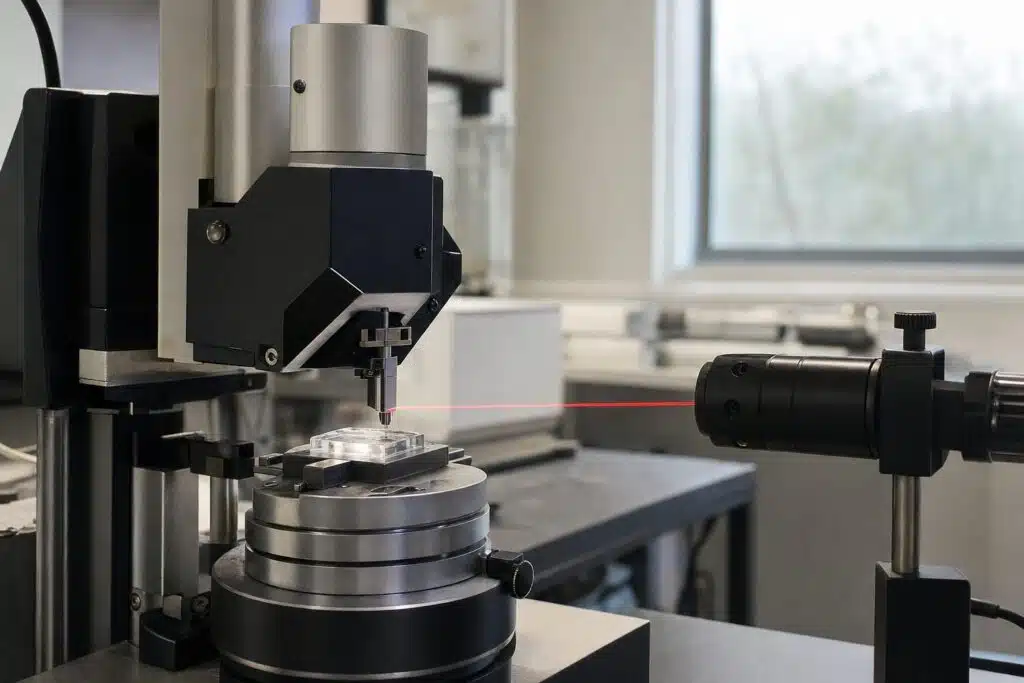
Forces between the tip and the sample bend the cantilever, and a laser reflected off its back tracks that deflection. A feedback loop holds the tip-surface interaction constant while the scanner moves, and the correction signal at each point becomes the height value in the image. The tip radius is a few nanometres to a few tens of nanometres, and the instrument works in air, liquid or vacuum. For a comparison with electron microscopy, see our guide to AFM vs. SEM surface imaging, and if your sample conducts, AFM vs. STM shows when a tunnelling microscope is enough.
Where does vibration enter an AFM image?
Any floor or acoustic motion that moves the sample relative to the tip adds directly to the height signal, because the instrument cannot tell a surface step from a vibration of the same size. The isolator has to attenuate that motion before it reaches the stage, which is why air or negative-stiffness platforms with a resonance of 0.2 to 3 Hz are standard for AFM installations. A site survey, described above, shows whether the building excites that band. If you are also budgeting the microscope, the atomic force microscope price guide covers what moves the cost.
Frequently Asked Questions
What is the difference between active and passive vibration isolation?
Passive isolation uses a spring/damper element with a fixed resonant frequency and only helps above that frequency. Active isolation senses residual motion and drives an actuator to cancel it in real time, achieving considerably stronger suppression.
When is active vibration isolation actually necessary?
Active isolation is documented as essential for sub-micrometre precision applications, specifically microchip production working on structures below 20 nanometres, where passive isolation alone cannot reach the required stability.
Is a softer, lower-frequency isolator always the better choice?
Not necessarily. In some mounting contexts there is a documented crossover, for example around 42 Hz for certain subframe designs, below which a rigidly bolted mount actually outperforms a compliant one.
What is AFM?
AFM (atomic force microscopy) scans a sharp tip on a cantilever across a surface and records the cantilever deflection to build a topographic image with a vertical resolution better than 0.1 nm. That sensitivity is why it needs low-resonance vibration isolation.
Why does AFM need low-resonance vibration isolation?
AFM resolves sub-nanometre features, so floor and acoustic vibration below that scale appears directly in the image, which is why negative-stiffness or air isolation platforms with sub-3 Hz resonance are standard for AFM.
Should I run a vibration survey before choosing an isolator?
Yes, for the most vibration-sensitive installations. A site vibration survey measures the actual floor spectrum, since an isolator chosen purely from a datasheet risks landing its resonance inside a band the building is already exciting.
Active vs. passive vibration isolation: which should I buy?
For the great majority of lab instrumentation, a well-matched passive isolator is enough, and NewRoad Agencies supplies MinusK's negative-stiffness passive isolation platforms in Israel, which reach some of the lowest practical resonant frequencies (0.2-0.5 Hz) of any passive technology. Active isolation is only the documented requirement once a process needs sub-micrometre precision, such as sub-20 nm semiconductor work.
Specifying a vibration isolation platform for AFM, interferometry or nanofabrication?
Explore the full vibration isolation systems technology page, the AFM systems it most often protects, or our comparison of AFM vs. SEM surface imaging.
Sources: Vibration isolation and Active vibration control, Wikipedia (both verified 19 Sep 2026). Describes isolator classes generally, not specific models.
Last updated: September 2026.