A contact angle goniometer measures how a liquid drop wets a solid by imaging the drop from the side and calculating the angle where the drop edge meets the surface. Water angles below 90° mean a hydrophilic surface, above 90° a hydrophobic one, and above 150° a superhydrophobic one. Modern instruments, also called optical tensiometers, automate drop dispensing, imaging and fitting, and also measure surface tension.
Key takeaways
- Water contact angle below 90° = hydrophilic, above 90° = hydrophobic, above 150° = superhydrophobic.
- Clean bare metal and ceramic surfaces can approach 0°; fluorinated low-energy materials reach about 120°; a lotus leaf about 147°.
- Contact angle hysteresis is the advancing angle minus the receding angle, and it reveals roughness and chemical heterogeneity.
- Values reproducible to better than a few degrees need purified liquids and very clean surfaces.
- The sessile drop method, a drop resting on the surface and imaged by a camera, is the most common measurement.
Table of Contents
- What Is a Contact Angle Goniometer?
- How Does Contact Angle Measurement Work?
- How Do You Interpret a Contact Angle?
- Contact Angle Ranges at a Glance
- Why Measure Advancing and Receding Angles?
- What Causes Unreliable Contact Angle Results?
- How Do You Choose a Goniometer?
- Optical vs. Force Tensiometer: Which Should You Buy?
- Frequently Asked Questions
What Is a Contact Angle Goniometer?
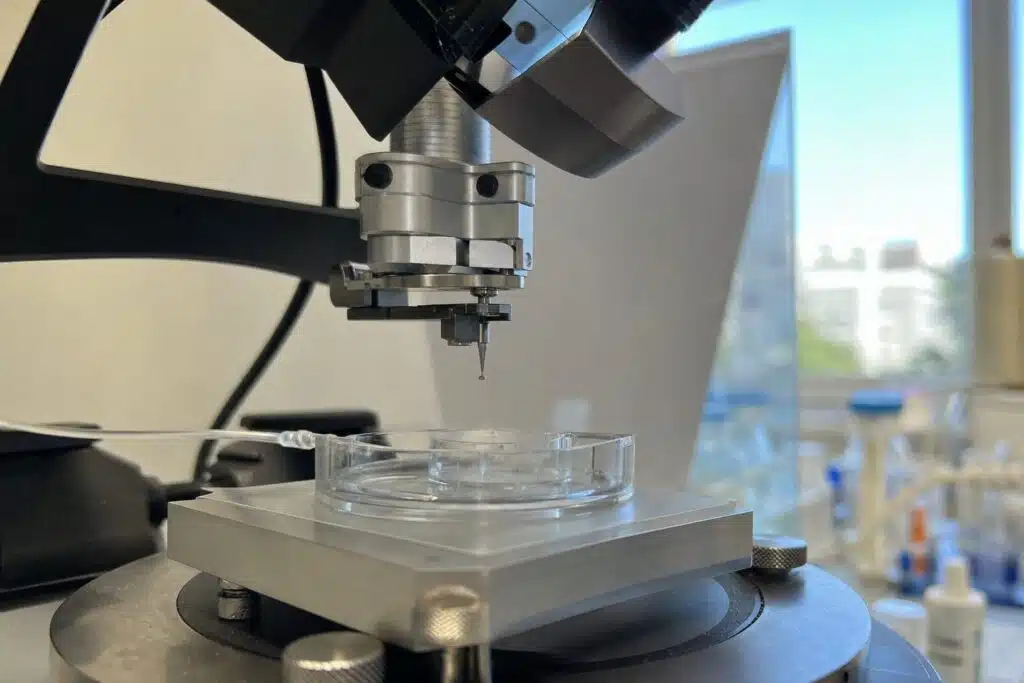
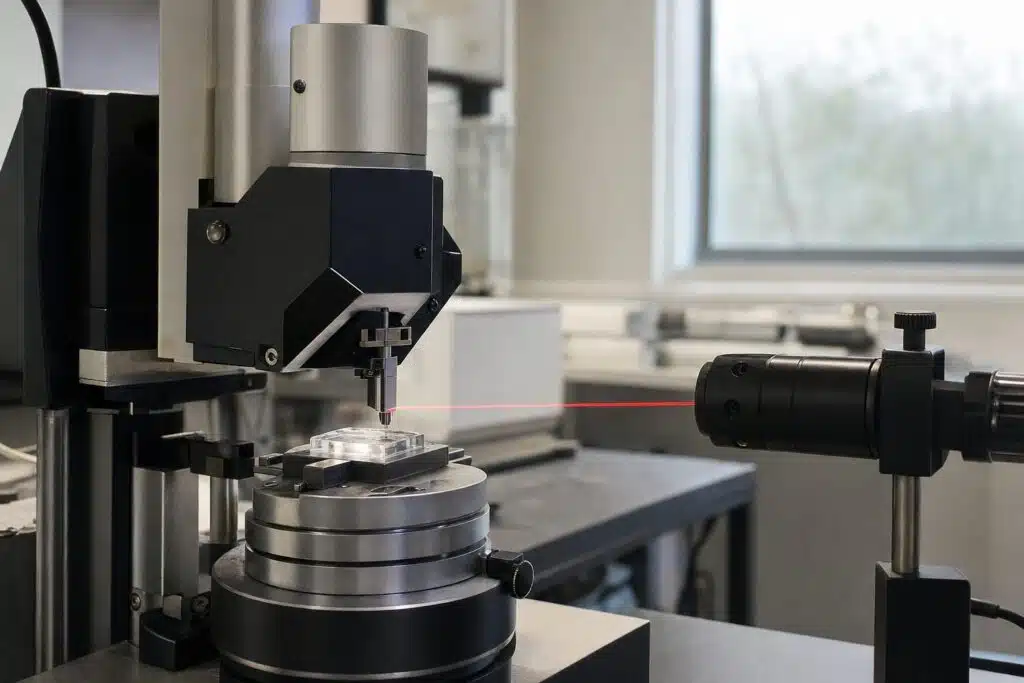
A contact angle goniometer is an optical instrument with three essential parts: a dispenser that places a drop of known liquid on the sample, a light source behind the drop, and a camera that records its silhouette. Software finds the drop outline and the baseline where it meets the solid, then calculates the angle between them. The name comes from early instruments that used a protractor-style goniometer eyepiece; today the measurement is fully image-based.
Labs use contact angle to check cleaning and plasma treatment, control coating and adhesion quality, develop hydrophobic or anti-fog surfaces, qualify wafers before bonding, and study wettability of membranes, textiles and biomaterials. Film thickness on such coatings is usually checked separately, for example by ellipsometry of thin films.
How Does Contact Angle Measurement Work?
Young’s equation
At equilibrium, three interfacial tensions pull on the drop edge: solid-gas, solid-liquid and liquid-gas. Young’s equation, γSG − γSL − γLG cos θ = 0, links them to the contact angle θ. Because the liquid surface tension is known, measuring θ with several liquids lets you calculate the surface free energy of the solid, which predicts how well paints, adhesives and inks will wet it.
The sessile drop method
In the sessile drop method a drop is placed on the surface and imaged from the side. It is the default measurement on every optical tensiometer because it is fast, needs a small sample area and works on most flat solids.
Other methods on the same instrument
The same optics also run pendant drop surface tension measurements, where a drop hangs from a needle and its shape gives the liquid’s surface tension. Tilting the sample stage or growing and shrinking the drop gives dynamic angles, discussed below.
How Do You Interpret a Contact Angle?
A low water contact angle means the liquid spreads because the surface has high energy relative to the liquid; a high angle means the liquid beads up. For water, the 90° line is the conventional boundary between hydrophilic and hydrophobic. Superhydrophobic surfaces, above 150°, trap air pockets beneath the drop, so the drop sits partly on air rather than on solid.
Trends often matter more than single values. A plasma-treated polymer that drops from a high angle to a low one, then creeps back up over days, shows hydrophobic recovery, which is a direct input to how long treated parts can wait before bonding.
Contact Angle Ranges at a Glance
| Water contact angle | Classification | Example surface |
|---|---|---|
| About 0° | Complete wetting | Clean bare metal or ceramic |
| Below 90° | Hydrophilic | Plasma-treated or oxidized surfaces |
| Above 90° | Hydrophobic | Many untreated polymers |
| About 120° | Strongly hydrophobic | Fluorinated low-energy materials |
| About 147° | Near superhydrophobic, from roughness | Lotus leaf |
| Above 150° | Superhydrophobic | Engineered textured coatings |
Why Measure Advancing and Receding Angles?
A single static angle can hide a lot. The advancing angle is the maximum angle reached as liquid is added and the drop edge moves outward; the receding angle is the minimum reached as liquid is withdrawn. Their difference is the contact angle hysteresis, θA − θR.
What hysteresis tells you
Large hysteresis points to surface roughness, chemical patchiness or contamination, and it predicts how easily drops slide off. As an illustration, a coating with an advancing angle of 110° and a receding angle of 95° has 15° of hysteresis; two coatings with the same static angle can behave very differently in use if their hysteresis differs.
Roughness correction
Roughness amplifies wetting behavior, making hydrophilic surfaces look more hydrophilic and hydrophobic ones more hydrophobic. Instruments that measure surface topography alongside the angle can separate the chemical contribution from the roughness contribution.
What Causes Unreliable Contact Angle Results?
Contact angles are extremely sensitive to contamination. Values reproducible to better than a few degrees are generally obtained only under laboratory conditions, with purified liquids and very clean solids. The common culprits:
- Contaminated liquid: traces of surfactant in the probe water lower its surface tension and every angle measured with it.
- Handling: fingerprints and airborne hydrocarbons change the surface within minutes.
- Baseline placement: a tilted stage or reflective sample shifts the baseline and the fitted angle.
- Evaporation: small drops shrink during long measurements, turning a static reading into a slow receding one.
How Do You Choose a Goniometer?
Start from the samples and the decisions the numbers drive. The right contact angle goniometer for a production line is rarely the right one for a surface-chemistry lab. Routine quality checks on flat parts need a robust, simple instrument; research on surface energy, dynamic angles or rough surfaces needs automation and more measurement modes. NewRoad represents Biolin Scientific in Israel, whose Attension Theta optical tensiometer line covers these cases:
- Theta Lite: a compact instrument built for quality control and basic wettability research, measuring contact angle, dynamic contact angle, surface tension and surface free energy.
- Theta Flex: a modular instrument designed for both research and quality control, with every measurement mode included in the software as standard.
- Theta Topography: adds roughness-corrected contact angle to the Theta Flow and Theta Flex, measuring 3D roughness by fringe projection.
- Theta Wafer: fully automated measurements across silicon wafers from 2″ up to 12″.
- Theta High Pressure: wettability and interfacial tension at up to 400 bar and 200 °C, for enhanced oil recovery and supercritical fluid work.
Product details above are taken from the Biolin Scientific product descriptions on each linked page. For force-based surface and interfacial tension, see the force tensiometer range, and for thin-film interaction studies, our explainer on QCM-D.
Optical vs. Force Tensiometer: Which Should You Buy?
Buy an optical tensiometer when the question is how a liquid wets a solid, and a force tensiometer when you only need the surface tension, interfacial tension or density of a liquid. An optical instrument images a drop and gives contact angle, surface free energy and, with the pendant drop method, surface and interfacial tension. A force tensiometer weighs the pull on a ring, plate or rod and reports surface tension, interfacial tension and liquid density, and the top model adds more measurement modes.
| What you need to measure | Optical tensiometer (Theta) | Force tensiometer (Sigma) |
|---|---|---|
| Static contact angle | Yes: sessile drop, captive bubble and meniscus | Not listed |
| Dynamic contact angle | Yes: advancing, receding, hysteresis, roll off angle | Advancing and receding angles on Sigma Peak |
| Surface free energy | Yes | Not listed |
| Surface and interfacial tension | Yes: pendant drop and reverse pendant drop | Yes: Du Noüy ring, Wilhelmy plate or rod |
| Liquid density | Not listed | Yes |
| CMC, adhesion force, powder wettability, sedimentation | No | Sigma Peak |
| Batch quality control | Batch sessile drop | Routine tension and density checks |
NewRoad supplies both families from Biolin Scientific in Israel. On the optical side, Theta Lite suits quality control and basic wettability research, and Theta Flex brings all measurements into one instrument. On the force side, Sigma Base is fully manual and runs without a PC, which suits teaching and routine quality control; Sigma Solo adds automation for everyday analysis; and Sigma Peak adds dynamic contact angle, CMC, adhesion force, powder wettability and sedimentation. Compare the optical tensiometer and force tensiometer technology pages for the full range. Specifications are taken from the product pages, verified October 2026.
Frequently Asked Questions
What does a contact angle goniometer measure?
It measures the angle formed where a liquid drop meets a solid surface, which describes how well the liquid wets the solid. Most instruments also measure liquid surface tension with the pendant drop method.
What contact angle is hydrophobic?
A water contact angle above 90° is conventionally hydrophobic, below 90° is hydrophilic, and above 150° is superhydrophobic.
What is contact angle hysteresis?
It is the difference between the advancing and receding contact angles. Large hysteresis indicates roughness, chemical heterogeneity or contamination, and relates to how easily drops slide off a surface.
How accurate is contact angle measurement?
Reproducibility better than a few degrees is achievable in laboratory conditions with purified liquids and clean surfaces. Contamination is the largest source of error.
Is an optical tensiometer the same as a goniometer?
In current usage, yes. Optical tensiometer is the broader name for a camera-based instrument that measures contact angle and also surface and interfacial tension from drop shape.
Where can I buy a contact angle goniometer in Israel?
NewRoad represents Biolin Scientific in Israel and supplies the Attension Theta optical tensiometer line, from compact quality-control units to research, wafer and high-pressure configurations.
Optical tensiometer or force tensiometer: which should I buy?
Buy an optical tensiometer if you need contact angle, surface free energy or drop-shape surface tension. Buy a force tensiometer if you only need surface tension, interfacial tension or density of liquids, or CMC and adhesion measurements on the Sigma Peak.
Measuring wettability, cleanliness or surface energy?
Explore the full optical tensiometer technology page and the Biolin Scientific range.
Sources: Contact angle and Sessile drop technique, Wikipedia (verified September 2026). The 110°/95° hysteresis figure is an illustrative example, not a measured value.
Last updated: October 2026.